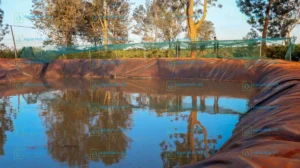

Water containment has become easier with Aqua Hub’s high-quality dam liners. Our dam liners are hard, flexible and waterproof sheets of 0.3 mm, 0.5 mm, 0.75 mm and 1 mm thickness. Dam Liner prices in Kenya are between KES 100,000 to KES 360,000 per roll depending on the thickness.
Dam liners are essential in areas with porous soils where water retention is difficult without a barrier. They are widely used for crop irrigation, livestock watering, and fish farming.
1mm Dam Liner Prices in Kenya

For premium 1 mm dam liner, prices in Kenya currently range between KES 380 and KES 450 per square meter.
Call 0711138312
Dam Liner Prices in Kenya
| Thickness | Price Range (KES/m²) | Typical Lifespan | Best Use Case |
| 0.5 mm | KES 220 – 250 | 10–15 Years | Small ponds, smooth clay soil |
| 0.75 mm | KES 320 – 350 | 20–25 Years | Medium dams, some stones |
| 1.0 mm | KES 380 – 450 | 25–35 Years | Large reservoirs, rocky ground |
Dam Liner Thickness Explained
The thickness of dam liners is measured in millimetres (mm) or microns.
| Thickness | Microns | Best For | Typical Lifespan |
| 0.3 mm | 300 | Small ponds | ~8-12 years |
| 0.5 mm | 500 | Medium ponds | ~12-20 years |
| 1.0 mm | 1000 | Large dams & heavy duty | ~20-35 years |
Dam Liner Quality: Why 1mm Gauge is More Ideal
Quality dam liners are manufactured from high-density polythene material. While thinner liners exist, the 1.0mm thickness represents the “commercial grade” benchmark. It offers a unique balance of extreme puncture resistance and long-term UV stability. Unlike cheaper alternatives that might crack after three seasons of intense Kenyan sun, a virgin-grade 1 mm HDPE liner is engineered to last upwards of 25 to 35 years.
For rocky terrain or “murram” soils, the 1mm thickness provides a critical safety buffer. It is dense enough to withstand the weight of thousands of cubic meters of water without stretching thin over sharp subterranean edges. This density is what makes it a high-performance geomembrane, capable of maintaining structural integrity even when the ground beneath it shifts slightly due to moisture changes.
Types of Dam Liners in Kenya
- HDPE (High-Density Polyethylene): The most popular for large-scale irrigation. It is rigid, UV-treated, and chemically resistant.
- PVC (Polyvinyl Chloride): More flexible and easier to handle for DIY projects, but generally more expensive and less durable under direct sunlight.
- LDPE (Low-Density Polyethylene): The budget-friendly “entry-level” liner. While highly flexible, it has lower tensile strength and is prone to tearing if used in deep reservoirs.
A unique insight often overlooked is the linear expansion coefficient. HDPE expands and contracts with temperature. A 1mm liner handles this mechanism much better than thinner gauges, preventing the stress cracks that often appear at the waterline where the sun hits the exposed material most intensely.
Dam Liner Measurements: How to Calculate What You Need
Mistakes in dam liner measurements calculation lead to expensive waste or, worse, a liner that doesn’t reach the anchor trench. To calculate the total area required for a standard rectangular dam, use this formula:
- Length Required = (Top Length) + (2 × Max Depth) + (2 Meters for Overlap/Anchoring)
- Width Required = (Top Width) + (2 × Max Depth) + (2 Meters for Overlap/Anchoring)
Where to Buy: Top Dam Liner Supplier in Kenya
Aqua Hub Kenya.
Call 0711138312.
Dam liners in Nairobi
1mm dam liner prices in Nairobi are customer friendly at Aqua Hub LTD. We also have 0.75 mm, 0.5 mm and 0.3 mm.
Dam liners in Nakuru
We deliver quality dam liners to farmers in Nakuru, the entire Rift Valley and even Kisumu and western region.
Dam Liner Installation Steps
The steps for proper dam liner installation include:
- Prepare the site by removing sharp stones and roots.
- Excavate to planned depth with sloping sidewalls.
- Use geotextile underlay if soil is rocky.
- Anchor edges in trenches and cover with soil.
- Test for leaks before full water filling

How to Weld or Join a Dam Liner
You must understand how to weld or join a dam liner using thermal fusion. This process involves a hot wedge welder or a hot air blower that melts the two edges of the HDPE sheets at roughly 300°C to 400°C, fusing them into a single, seamless piece.
It is crucial to ensure a 10cm to 15cm overlap between sheets for formation of a secure joint. When instal use a pressure roller to ensure no air bubbles are trapped in the seam. If you are doing a large-scale project, hiring a technician with a geomembrane welding machine is essential.
Maintenance and Longevity: How to Repair Dam Liner
Even the toughest 1mm liner can suffer damage from falling tools, sharp animal hooves, or extreme vandalism. In case of dam liner wear or damage, look for a technician to ensure proper repair.
Steps for a Successful Repair:
- Drain and Dry: The area must be bone-dry and scrubbed clean of any algae or silt.
- Roughen the Surface: Use light sandpaper to create “teeth” on the liner surface so the adhesive bonds better.
- Apply the Patch: Cut a circular patch (edges should be rounded to prevent peeling) and apply the dam liner repair tape or specialized glue.
- Heat Bond: If you have a hot welding blower, lightly heating the patch while applying pressure creates a much stronger “vulcanized” bond.
Beyond the Dam: Dam Liner Tanks and Modern Applications
Dam Liner Tanks are corrugated iron-tanks lined using dam liners. These lining technique combines the structural strength of Steel with the tough and waterproof nature of HDPE material. Instead of spending much on plastic tanks that limit your water storage capacity, these tanks store large water volume at lower cost.
Additionally, 1mm liners are being used in aquaculture (fishponds) where large catfish or tilapia are raised. The thickness prevents the fish from damaging the liner and makes cleaning the pond between cycles much easier, as the material can withstand high-pressure washing without tearing.
Frequently Asked Questions
1. What is the average 1 mm dam liner price in Kenya per square meter?
Between KES 380 and KES 450
2. Can I use a 1 mm liner for a fishpond?
Yes, 1mm liners are excellent for large fishponds.
3. How much liner do I need for a rectangular dam?
depends on the size of the dam.
4. How long does a 1.0 mm HDPE dam liner last?
25 and 30 years.
5. Do dam liner suppliers in Kenya offer installation?
Aqua Hub LTD offers installation.
6. What causes a dam liner to leak?
Poor site preparation (leaving sharp rocks), improper welding, or mechanical damage from livestock or tools.
7. Can I install a dam liner on rocky ground?
Use a 1mm dam liner. recommend using an underlay sand layer for extra protection.
8. Where can I find dam liners in Nakuru?
Aqua Hub also serves customers within Nakuru region.
9. Is a 0.5mm liner better than a 1mm liner?
0.5 mm is cheaper, but a 1 mm dam liner will last longer.
10. How do I know if the liner I am buying is high quality?
Buy from certified suppliers who deal with new UV-treated liners.