Learn how you can easily top-dress your crops without having to spend on labour or worry about efficiency. Aqua Hub’s quality venturi injectors are designed to ensure long lifespan and efficient fertilizer supply. Venturi Injector or fertigation kit is an economical and highly efficient device for applying fertilizers to crops. Using venturi fertilizer kit lowers the cost of fertigation and ensures no waste of input fertilizers. Soluble nutrients are fed into the system and equally distributed to the root zones of crops through drip irrigation system.
Components of a Venturi fertigation kit
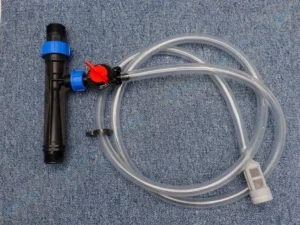
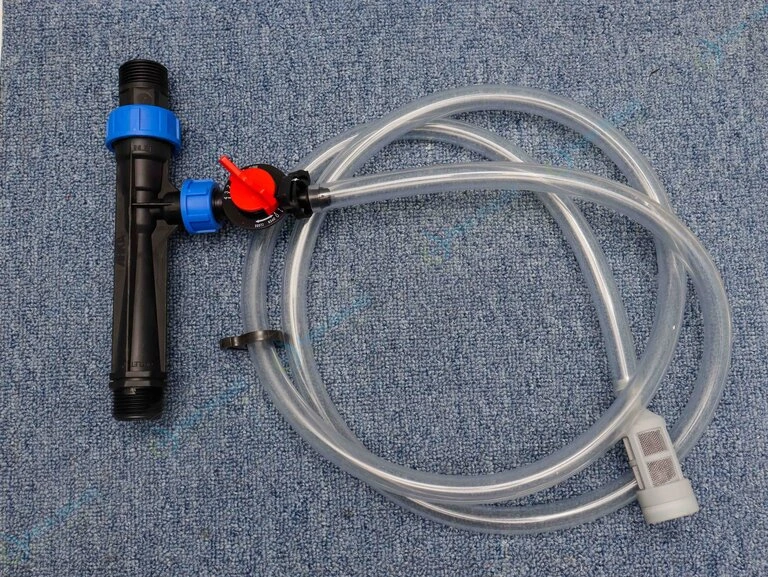
Most venturi injectors consist of:
- A Venturi tube (main body) with a constricted throat and inlet/outlet ends.
- A suction port (threaded connection) where a hose from the fertilizer tank connects.
- A check valve to prevent backflow of fertilizer into the tank.
- Optional control valves or adjustment valves to fine-tune suction/injection rate.
- A suction hose (immersed in the fertilizer solution), sometimes with a filter/strainer to prevent solids entering the injector.
Most venturi injectors are made of durable, corrosion-resistant plastic ideal for fertilizers and field conditions.
How a Venturi Fertilizer Injector Works
- When you open the irrigation water flow, water travels through the mainline toward your drip or sprinkler system.
- As it enters the venturi injector’s narrow throat, velocity increases, causing pressure to drop.
- This drop in pressure creates a vacuum that sucks fertilizer solution from the connected reservoir into the water stream.
- The water-fertilizer mix then flows down the irrigation lines and reaches your crops.
Because mixing happens automatically with flow, fertigation becomes as simple as opening the water tap saving time and effort.
Basic Fertigation ratios and mixing logic
Most venturi fertilizer injectors operate on a proportional mixing basis. For example:
- A 1:100 ratio means 1 part fertilizer solution to 99 parts water (i.e., a 1% solution).
- The actual ratio depends on your injector’s design and the flow rate through your system.
By correctly calculating and mixing your stock solution, you ensure crops get the right nutrient concentration neither under-fed nor over-fed.
Integration with drip and sprinkler irrigation systems
Venturi injectors are highly compatible with drip irrigation.
They are often installed at the head or mainline section of the irrigation system, to ensure all downstream emitters receive the fertilized water.
Choosing the Right Venturi Injector for Your Farm
Match injector size to irrigation flow rate and pipe diameter
Selecting the correct size is critical: too small injector may restrict flow or fail to produce vacuum; too large may fail to draw fertilizer effectively.
Common venturi injector sizes range from ½ inch, ¾ inch, 1 inch, up to 2 inches. Choose based on your farm’s pipe diameter and flow rate.
Assess water pressure
Venturi injectors rely on a sufficient pressure differential between injector inlet and outlet. Many models need a minimum drop e.g. 5 – 20 % to create suction.
If your water pressure is too low, a venturi injector may not work properly.
Considering fertilizer types and solubility
Venturi injectors are compatible with water-soluble fertilizers such as NPK blends, nitrates (e.g. calcium nitrate, potassium nitrate), urea, etc.
It’s important that fertilizers are fully dissolved in water before suction; undissolved granules or sediments may clog the injector throat or filter.
Installation of Venturi Injector
Valve & bypass assembly — why bypass is often better than inline
Rather than installing the injector directly inline, it’s ideal to use a bypass assembly. This allows part of the water flow to divert through the injector, while the main flow continues unaffected minimizing pressure drop and preventing potential flow restriction.
By using valves, you can control how much water (and fertilizer) flows through the injector, improving dosing accuracy and system reliability.
Orientation and flow direction
For reliable suction, venturi injectors should be installed horizontally or vertically upward, following the flow arrow marked on the injector body.
Avoid vertical downward installation suction becomes erratic or may fail. Also ensure the suction hose remains submerged in the fertilizer tank to prevent air intake.
Proper fittings, seals, suction tube placement and priming
Use “full flow” valves and ensure pipe fittings match the injector thread size (don’t downsize the pipe right after the injector).
Seal all connections properly (e.g., use thread tape), ensure suction hose reaches to bottom of fertilizer tank, and prime the injector (i.e., run water until fertilizer starts entering the line) before full operation. A check valve helps prevent backflow.
Benefits of Venturi Injectors
- Uniform fertigation – soluble fertilizer is evenly mixed and distributed to crops together with irrigation water. It allows control of the amount of fertilizer you apply to your crops.
- Saves on Labour Cost – when fertilizer injectors are applied, no need to apply fertilizer manually. For this reason, you don’t need manual labour.
- Highly durable – designed from UV treated plastic material.
- Low maintenance needs – no moving parts, operates on the principle of water pressure, no frequent damages.
Maintenance of Fertigation Kit
Regular cleaning and filter maintenance
Since the suction hose draws fertilizer solution directly, it’s critical to clean or replace the suction filter/strainer regularly. This prevents sediment buildup or clogging, which can block fertilizer flow.
Scheduling cleaning e.g., weekly or after each fertigation cycle — helps maintain consistent suction and prolongs injector life.
Checking for air leaks or worn-out suction parts
Air leaks in suction tubing or loose connections will break the vacuum and stop fertilizer from being drawn. Periodically inspect all tubing, gaskets, and seals.
Replace worn or brittle suction parts as needed especially if exposed to sun or chemical fertilizers for long periods (common in African farming contexts).
Flushing after fertigation cycles & calibrating dosage
After the fertigation run, flush the system with clean water to clear residual fertilizer this reduces buildup, prevents blockages, and prolongs dripline and emitter life.
Also, regularly check fertilizer concentration (e.g., using EC meter) to ensure nutrient dosing remains within desired levels. This is especially useful if water flow or pressure fluctuates over time.
Common Problems with Venturi Fertigation and Troubleshooting Tips
No suction
At times the injector fails to draw fertilizer from the tank. Below are the causes and possible solutions to issues with venturi fertigation:
- Pressure differential may be too small (i.e., water flow too low) — consider increasing flow or adjusting valves.
- Suction hose may have air leak or not fully submerged — check for cracks, ensure hose tip is under liquid.
- Orientation may be wrong (e.g., downward) — reposition injector horizontally or upward.
- Injector may be oversized relative to flow — choose a smaller size or increase water flow.
Clogging
Clogging usually happens due to undissolved fertilizer particles or sediment. If suction stops, check the filter/strainer first. Regular cleaning and ensuring full dissolution of fertilizers before use are key preventive measures.
Uneven fertilizer distribution
Incorrect mixing ratio or inconsistent suction can lead to over-concentration or under-fertilization. Always calculate fertilizer dosage carefully and calibrate injection rate according to water flow and crop needs.
Application of Venturi Injectors on Different Farm Cases
Smallholder farms (garden, vegetable bed)
For home gardens or small vegetable beds, a small-size venturi injector (e.g., ½″ or ¾″) can be ideal and cost-effective. It allows you to combine watering and fertilizing in one action saving time and labour.
For instance, a small vegetable plot irrigated via drip lines can benefit from regular 1% fertilizer mixes ensuring consistent nutrient supply without daily manual top-dressing.
Medium-sized farms (vegetables, horticulture, orchards)
On medium plots (e.g., horticulture, vegetables, orchard), a well-chosen venturi (1″ or 2″) can handle higher flow rates and deliver uniform nutrition across many rows. Fertilize injectors are often used to apply NPK or nitrate-based fertilizers directly through drip systems.
Scaling up: combining multiple injectors or pump-driven systems
If your farm is large or with many irrigation zones, you should install multiple venturi injectors on different zones. You can also consider upgrading to pump-driven proportional dosing systems for more precise control and higher volumes. This hybrid approach retains simplicity yet allows scaling.
Limitations of Venturi Fertigation Systems
Dependence on water flow & pressure — limitations for low-flow drip systems
Venturi injectors only work if there is adequate flow and pressure differential. On low-flow systems e.g., small drip lines with low GPM be inconsistent.
This makes venturi systems less suitable for very small plots with minimal irrigation infrastructure.
Less precise than proportional pump-driven injectors
While venturi injectors are simple and cheap, they are less precise compared to electric or pump-driven dosing systems (which maintain fixed doses regardless of flow changes). Variations in flow or pressure can alter fertilizer concentration.
Need for regular monitoring and manual calibration
To maintain consistent nutrient delivery, you must regularly check flow rates, fertilizer concentration. Clean filters and inspect suction lines otherwise performance degrades over time.
Venturi Injector vs Electric Dosing Pump
| Feature | Venturi Injector | Dosing Pump |
| Power needed | No power needs | Electricity required |
| Cost | cheap | Expensive |
| Precision | Medium. depends on flow/pressure | High. fixed dosing regardless of flow changes |
| Maintenance | Low | Medium to high |
| Suitability | Small–medium farms with stable pressure | Variable-sized farms, precise fertigation, high value crops |
When to Use Venturi and when to Avoid using it
Choose Venturi if: you have a stable, moderately pressured irrigation supply; want low-cost, low-maintenance fertigation; practice drip or sprinkler irrigation on small/medium plots.
Avoid Venturi if: your water flow is low or inconsistent; you need precise nutrient dosing; or your farm is large and requires large volumes with stable concentration.
Tips for Using Venturi Injectors in Kenya
Considering water pressure & flow conditions
Check whether your water system delivers enough flow before buying a venturi injector. Using a bypass setup and suitably sized injector (e.g., 1″) increases success.
Common fertilizer types in Kenya and compatibility
Venturi injectors work well with common, water-soluble fertilizers used in Kenya such as NPK blends, calcium nitrate, potassium nitrate, urea (CAN), and other soluble fertilizer brands.
Make sure fertilizers are fully dissolved before suction to avoid clogging a quick stir and filtration helps.
Buying the right fertigation Kit
When buying, check that the injector body, suction hose, check valve and fittings come as a complete kit.
At Aqua Hub LTD, we stock the right quality venturi injectors at affordable prices.
Frequently Asked Questions (FAQs)
No. The irrigation system needs to have correct pressure and flow rate for suction to occur. It is compatible with low pressure irrigation systems such as drip irrigation.
Water-soluble fertilizers such as NPK blends, calcium nitrate, potassium nitrate, urea (CAN).
Common sizes range from ½″, ¾″, 1″ up to 2″.
No. Venturi injectors can work without pumps by relying on pressure difference.
Clean suction filters regularly, inspect suction hose and seals for leaks, flush the irrigation system after fertigation, and periodically check fertilizer concentration (e.g., with EC meter)
Common causes include insufficient water flow or pressure, air leaks in suction hose, suction hose not immersed in fertilizer, wrong injector orientation, or a clogged suction filter.
Yes. when properly installed and calibrated, venturi injectors deliver uniform nutrient concentration throughout the irrigation system.
They can be, especially if you use multiple injectors or combine venturi systems with fertigation tanks
KES 1,500 to KES 4,500.
Yes. because nutrients are delivered directly to the root zone via drip irrigation, there is less runoff and leaching, which reduces environmental pollution.